The ZTE G6 Ultra is the world’s first fixed wireless access router to combine 5G-A (Release 18) cellular with Wi-Fi 8 and an on-device AI engine. It was announced at MWC Barcelona in March 2026 and represents a genuine step change in what a home or small business router can do. This guide covers everything known about the device, puts it in context against the rest of ZTE’s 5G FWA range, and explains what the technology actually means in plain terms.
What is the ZTE G6 Ultra?
The G6 Ultra is an indoor 5G FWA CPE (Customer Premises Equipment). That means it is a standalone box you plug in at home or in the office. It takes a SIM card, connects to the 5G network, and distributes Wi-Fi around the building. No fixed line. No engineer visit to install fibre.
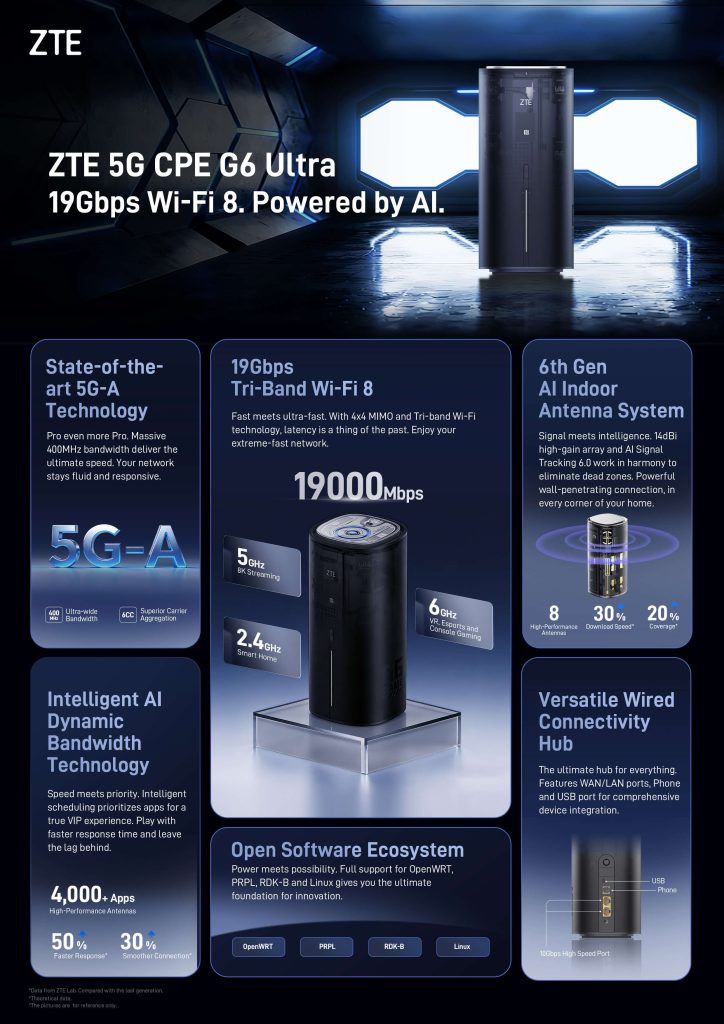
What separates it from every other FWA router currently on the market is the combination of three things arriving in the same box at the same time: 5G-A (the next phase of 5G, also called 5G Advanced or Release 18), Wi-Fi 8 (the newest Wi-Fi standard, formally IEEE 802.11bn), and an embedded AI layer that actively manages both the cellular connection and the local Wi-Fi network.
ZTE unveiled it at MWC Barcelona on 5 March 2026 alongside the G6 Max, an outdoor CPE aimed at longer-range deployments. Both run on the Qualcomm Dragonwing FWA Gen 5 platform, specifically the Snapdragon X85 5G Modem-RF System – the most advanced fixed wireless chip Qualcomm has produced to date.
5G-A: what it means and why it matters here
Most 5G routers on sale today run on 3GPP Release 15 or Release 16 specifications. Good hardware. But the standard caps out at a certain level of carrier aggregation and bandwidth.
5G-A (Advanced) refers to 3GPP Release 18, sometimes called R18. It extends the 5G standard significantly. The key differences relevant to the G6 Ultra are:
- 6-carrier aggregation (6CC). The device can combine up to six separate frequency carriers simultaneously. Most current 5G devices manage two or three. More carriers means more raw bandwidth pulled from the network at once.
- 400MHz channel bandwidth. Wider channels carry more data per transmission cycle. 400MHz is double what most mid-band 5G deployments currently use.
- Peak downlink of 10Gbps. This is a theoretical maximum under ideal conditions with a 5G-A network present. In practice you will not hit 10Gbps, but the ceiling being that high means real-world speeds well beyond what current FWA routers can achieve.
The important caveat: 5G-A networks are still being rolled out. Most UK operators are running R15/R16 infrastructure in 2025 and 2026. The G6 Ultra is designed to be ready for 5G-A deployments as they arrive, rather than for networks that exist everywhere today. That is not unusual for flagship CPE – the MC888 Ultra was announced ahead of widespread Wi-Fi 6E network infrastructure in the same way.
Wi-Fi 8: the G6 Ultra as a “design ready” device
Wi-Fi 8 (IEEE 802.11bn) is the successor to Wi-Fi 7. The standard has not been formally ratified as of early 2026, which is why ZTE describes the G6 Ultra as a “Wi-Fi 8 design ready” CPE rather than a fully certified Wi-Fi 8 device.
What that means in practice: the hardware is built around Wi-Fi 8 capabilities – the radios, the antenna arrays, the processing headroom – but the final certification and some features may require a firmware update once the IEEE standard is published.
The G6 Ultra’s Wi-Fi 8 implementation is tri-band 4MIMO. Breaking that down:
- Tri-band means three simultaneous radio bands operating in parallel (2.4GHz, 5GHz, and 6GHz).
- 4MIMO refers to four spatial streams per band, significantly increasing throughput and spectral efficiency compared to Wi-Fi 7’s typical 2×2 or 4×4 MIMO configurations per band.
- Combined Wi-Fi throughput is cited by some sources as up to 19Gbps across all bands simultaneously. That is a theoretical aggregate – no single client device will receive 19Gbps – but it indicates the capacity available when multiple devices are connected at once.
Wi-Fi 8 also brings improvements in multi-link operation, coordinated interference management, and latency reduction over crowded spectrum. In a dense residential block with many competing Wi-Fi networks, these improvements are more tangible than the raw speed headline suggests.
The antenna system
ZTE’s antenna work is often underplayed in coverage of this device. The G6 Ultra uses what ZTE calls the 6th Generation Indoor AI Antenna Solution. The headline specification is 14dBi gain, which is meaningfully high for an indoor CPE. Most indoor FWA routers sit in the 5 to 8dBi range. Higher gain means better signal reception from more distant cell sites, and more resistance to indoor building losses.
The antenna system runs ZTE’s beam scanning algorithm version 6.0. This means the device does not rely on a fixed antenna pattern. It actively scans for the strongest signal path from the cell tower and adjusts the beam direction accordingly. In buildings where the 5G signal comes in at an oblique angle – which is most buildings – this makes a measurable difference to received signal quality.
According to ZTE’s own testing, the 6th Gen antenna solution delivers a 30 percent increase in download speeds and 20 percent wider coverage compared to the previous generation used in the G5 Ultra.
The AI layer
AI is heavily marketed across consumer electronics right now and often amounts to nothing. In the G6 Ultra’s case there are specific, verifiable functions being performed by the on-device AI that are worth examining carefully.
Application identification
The device’s AI engine classifies over 4,000 known applications by traffic type in real time. Video streaming, gaming, video calls, file downloads, IoT sensor traffic – each gets identified and categorised at the packet level. This is deep packet inspection combined with machine learning models, not simple port-based classification.
Dynamic bandwidth allocation
Once applications are classified, the AI applies dynamic Quality of Service rules. A 4K video stream gets prioritised differently to a background software update. A VR gaming session gets low-latency priority. According to ZTE, the result is a 20 percent improvement in overall bandwidth efficiency – meaning the same raw connection delivers more perceived performance because traffic is handled in the right order.
Latency and congestion reduction
ZTE claims the AI system reduces network congestion by 30 percent and latency by 50 percent compared to operation without AI QoS. These figures are relative to the device’s own baseline, not to competitor hardware. But 50 percent latency reduction is a bold claim and, if it holds up in real-world testing, would be significant for gaming and video conferencing use cases.
Power management
The AI also manages power consumption. It builds usage pattern models over time – learning when the household is active, when devices are idle, when certain services are in use – and adjusts radio power states accordingly. ZTE frames this as a green energy feature. It also extends component life, which is worth noting for operators deploying CPE at scale.
Key specifications summary
| Specification | Detail |
|---|---|
| Platform | Qualcomm Dragonwing FWA Gen 5 (Snapdragon X85 5G Modem-RF) |
| 5G standard | 3GPP Release 18 (5G-A / 5G Advanced) |
| Peak 5G downlink | 10Gbps |
| 5G bandwidth | 400MHz |
| Carrier aggregation | 6CC (6-carrier aggregation) |
| Wi-Fi standard | Wi-Fi 8 (IEEE 802.11bn, design ready) |
| Wi-Fi configuration | Tri-band, 4MIMO |
| Wi-Fi peak aggregate | Up to 19Gbps |
| Antenna | 6th Gen Indoor AI Antenna, 14dBi gain |
| Beam scanning | AI signal tracking algorithm 6.0 |
| AI capabilities | 4,000+ app classification, dynamic QoS, power management |
| Form factor | Indoor CPE |
| Announced | MWC Barcelona, March 2026 |
Note: Physical dimensions, port configuration, and band support have not been officially published as of May 2026. This page will be updated when a full datasheet is available. Do not rely on third-party spec sheets – several contain significant errors regarding this device.
The G6 Ultra in context: how it fits ZTE’s FWA range
ZTE has held the number one global position in FWA and mobile broadband market share for five consecutive years, according to TSR market data. The company has shipped over 300 million units across more than 100 countries. The G6 Ultra sits at the very top of that portfolio. Here is where each current model sits.
ZTE G6 Ultra – indoor flagship (2026)
The subject of this guide. Highest-specification indoor CPE ZTE has built. 5G-A, Wi-Fi 8, AI QoS. Aimed at operators deploying premium home broadband services in markets with 5G-A rollout underway. Not a consumer retail product in the traditional sense – this is carrier-grade CPE intended for operator distribution.
ZTE G6 Max – outdoor CPE (2026)
Announced alongside the G6 Ultra at MWC 2026. The G6 Max is the outdoor companion to the G6 Ultra and holds its own claim: it is the world’s first 5G-A outdoor CPE supporting both Sub-6GHz and mmWave simultaneously. It aggregates 800MHz of mmWave bandwidth with 400MHz of Sub-6GHz to deliver a peak downlink of 12.5Gbps. The 6th Generation Outdoor AI Antenna provides up to 14dBi gain and the device can reportedly maintain a 5G connection at up to 14km range under ideal propagation conditions. It carries IP67 weatherproofing and operates between -40 and +60 degrees Celsius. The G6 Max is built for fixed wireless in demanding environments where line-of-sight to a tower is available but the building itself cannot get a usable signal indoors.
ZTE G5 Ultra – indoor (2024/2025)
The direct predecessor to the G6 Ultra and still a capable device. The G5 Ultra was the previous flagship indoor CPE, using ZTE’s 5th Generation AI antenna architecture. It established ZTE’s AI bandwidth management approach and is the device against which the G6 Ultra’s 30 percent speed improvement claim is measured. Widely deployed by operators as a premium FWA broadband product.
ZTE G5F – outdoor 5G-A CPE (2024/2025)
An outdoor CPE targeting 5G-A Sub-6GHz networks. Peak rate of 10Gbps. Positioned for operators running high-density urban FWA deployments where outdoor mounting improves signal consistency. Sits below the G6 Max in the product hierarchy but shares the 5G-A positioning.
ZTE G5TS – entry-level indoor CPE
The accessible end of ZTE’s current FWA range. Dual-band Wi-Fi 6 rather than Wi-Fi 8 or Wi-Fi 7. Designed for markets where cost is the primary driver and 5G-A network rollout is not yet relevant. A workhorse product for emerging market operators and budget-tier deployments in developed markets.
ZTE MC889 / MC889A – outdoor CPE (current generation)
A widely deployed outdoor CPE running the Qualcomm Snapdragon X62 modem. Supports 5G SA and NSA modes with download speeds up to 2.7Gbps. IP65 weatherproofing (the Pro variant reaches IP67). Connects via PoE over a single Ethernet cable to an indoor Wi-Fi router such as the ZTE T3000. A two-box system – the MC889 handles cellular reception outdoors and the indoor router handles Wi-Fi distribution. Available in the UK through various channels at around £300 and regularly reviewed by UK users who need to mount a cellular antenna on an exterior wall to escape indoor signal loss. A practical, proven device rather than a flagship.
ZTE MC888 Ultra – indoor Wi-Fi 6E (2022/2023)
An earlier generation indoor CPE based on Qualcomm’s FWA Platform Gen 2 with the Snapdragon X65 modem. Supported Wi-Fi 6E at up to 6,000Mbps on the wireless side. Brought mmWave and Sub-6GHz NR carrier aggregation to the indoor CPE category and used ZTE’s smart antenna array 3.0 with 10dBi gain. Now superseded by the G5 and G6 series but still a reference point for the evolution of ZTE’s indoor FWA range.
Who should be looking at the G6 Ultra?
The honest answer is: operators, not consumers, right now.
The G6 Ultra is a carrier CPE device. ZTE sells it to mobile network operators, who provision and distribute it to end customers as part of a managed broadband service. You will not buy one from Amazon. The path to ownership is through your mobile operator – if and when they choose to offer it as part of a fixed wireless broadband package.
That said, it is worth understanding what the device enables:
Multi-person households with high bandwidth demand
A household with multiple 4K streaming sessions, active gamers, and several work-from-home setups simultaneously can saturate a standard FWA router. The G6 Ultra’s AI QoS and Wi-Fi 8 capacity are specifically designed for this load profile. The application classification engine allocates bandwidth intelligently rather than just sharing it equally between devices.
Small businesses without fibre access
Rural and semi-rural businesses that cannot get a fibre connection but do have a reasonable 5G signal can use FWA as a primary connection. The G6 Ultra’s 10Gbps cellular ceiling and Wi-Fi 8 wireless capacity make it feasible to run a small office entirely on 5G broadband without the compromises that older FWA hardware imposed.
Properties where fibre deployment is uneconomic
The UK still has significant numbers of properties that are not scheduled for fibre in the near term. Where 5G or 5G-A coverage is available, FWA is a credible alternative. The G6 Ultra reduces the performance gap between fixed wireless and fibre to its narrowest point yet.
Operators evaluating next-generation CPE
For operators planning 5G-A network rollouts, the G6 Ultra represents the first device that can actually utilise R18 network capabilities from day one. Planning a CPE refresh cycle around a device that supports 6CC carrier aggregation and 400MHz bandwidth means the installed base is ready when the network infrastructure catches up.
The “world’s first” question
ZTE’s press announcements use the phrase “world’s first” liberally. It is worth examining what is genuinely new here versus what is marketing positioning.
The combination of 5G-A (R18) with Wi-Fi 8 in a single indoor CPE does appear to be a genuine first. No other vendor had announced a commercially available device with both standards in the same box before the G6 Ultra’s MWC 2026 launch. The Qualcomm Snapdragon X85 chip underpinning it was also new at the time of announcement, with the G6 series among the first devices to be built around it.
The AI claims are harder to independently verify. ZTE has offered specific, measurable figures (50 percent latency reduction, 20 percent bandwidth efficiency improvement) which are more credible than vague references to “AI-enhanced connectivity.” Whether these numbers hold up across real-world operator deployments at scale remains to be seen. The architecture is sound – application classification and dynamic QoS are well-established network management techniques, and doing them on-device rather than in the network core is a meaningful design choice that reduces latency introduced by cloud-based policy engines.
5G-A in the UK: the timing question
The UK’s major operators – EE, Vodafone, Three, and O2 – are all running 5G infrastructure based on earlier 3GPP releases. As of early 2026, 5G-A (R18) network infrastructure is limited to trial deployments and specific high-density urban zones. The G6 Ultra cannot unlock its full 10Gbps R18 capability on a network that is not yet running R18 specifications.
This is not a reason to dismiss the device. Flagship CPE typically arrives ahead of the network capability it is designed for. The MC888 Ultra was announcing Wi-Fi 6E and mmWave Sub-6GHz aggregation capability before those network configurations were widespread. The G6 Ultra will run on current 5G networks using its legacy R15/R16 modes while 5G-A rolls out. The investment case is that the same device handles both.
UK operators have committed to 5G-A infrastructure investment as part of their network evolution roadmaps. The question is timing. Based on current trajectory, meaningful 5G-A commercial coverage in major UK cities is a 2026 to 2028 proposition depending on operator and geography.
Availability and pricing
As of May 2026, the ZTE G6 Ultra is not yet available through UK retail channels. ZTE typically distributes high-end CPE through operator partnerships rather than direct consumer routes. No UK operator has announced a G6 Ultra deployment at the time of writing.
Pricing will be operator-determined. Premium FWA CPE in the UK typically carries a hardware cost of £150 to £400 when offered as part of a broadband contract, or higher if sold as standalone hardware. Given the G6 Ultra’s specification level, expect it toward the upper end of that range or above.
This page will be updated when operator availability is announced. If you are researching FWA hardware available to buy in the UK today, see the ZTE MC889A and G5 Ultra guides elsewhere on this site.
Comparing the G6 Ultra to current alternatives
The G6 Ultra has no direct like-for-like competitor on the market at the time of writing. The closest comparable devices are the Huawei H138-380 (5G-A capable, Wi-Fi 7 rather than Wi-Fi 8) and the Nokia FastMile 5G (Wi-Fi 6E, no 5G-A). Neither matches the G6 Ultra’s specification on paper.
For the practical FWA buyer in the UK today, the meaningful comparisons are with ZTE’s own G5 Ultra (widely deployed via operators), the MC889A paired with a Wi-Fi router for properties with poor indoor signal, and competing indoor CPE from Huawei and Nokia at the mid-range. The G6 Ultra is not in that category yet. It is a preview of where the FWA market is heading rather than a product you can put on your windowsill this month.
Summary
The ZTE G6 Ultra is the most technically advanced indoor FWA CPE announced as of early 2026. Its combination of Qualcomm’s Snapdragon X85 platform, 3GPP Release 18 5G-A support, Wi-Fi 8 tri-band 4MIMO, and on-device AI network management puts it a clear generation ahead of what is currently deployed in UK homes.
The practical constraint is the same one that applies to every device at this end of the spectrum: the network needs to catch up. 5G-A rollout in the UK is underway but not widespread. Wi-Fi 8 clients are not yet in most homes. The full performance envelope of the G6 Ultra cannot be unlocked on today’s infrastructure.
That does not make it an irrelevant product. For operators planning CPE refresh cycles, it is the device to pilot now so deployments are ready when the network is. For households and businesses in areas where 5G-A arrives early, it will deliver performance that was not previously achievable on a fixed wireless connection.
ZTE’s five consecutive years at the top of the global FWA market share rankings are built on exactly this approach: pushing hardware capability ahead of the network curve, then delivering on it when the infrastructure catches up. The G6 Ultra is the latest expression of that strategy.
Sources: ZTE Corporation press release, MWC Barcelona 2026 (5 March 2026); Qualcomm Technologies Inc. product announcement; telecoms.com, mobileworldlive.com, theregister.com coverage of MWC 2026 announcements; TelecomLead FWA market analysis; LTEmall product database. Physical specifications and band support data not yet publicly available from ZTE at time of writing.