Posted by Peter Green | 5G FWA | May 2026
Ubiquiti has been building enterprise-grade networking kit for years. Solid Wi-Fi access points, managed switches, cloud-managed gateways – all wrapped in a genuinely good management platform called UniFi. Reliable, well-priced, and increasingly popular in commercial environments that need something more capable than a consumer router but do not want the complexity or the cost of full enterprise infrastructure.
The new UniFi Industrial range takes all of that and asks: what does it look like when you harden it for the real world?
The answer is the Cloud Gateway Industrial – and paired with Ubiquiti’s expanding 5G ecosystem, it is a compelling package.
The Black Box – Cloud Gateway Industrial (UCG-Industrial)
The UCG-Industrial is the anchor of the UniFi Industrial initiative. It is a fanless, ruggedised 10GbE gateway designed for environments where standard equipment falls short – manufacturing floors, outdoor installations, remote sites, construction compounds.
Fanless means no moving parts. No moving parts means no mechanical failure point, no dust clogging a heatsink, no fan dying silently at 2am on a warm July night. For any deployment where the hardware needs to just work without regular attention, that matters.
The spec list is substantial. Dual 10GbE WAN ports. Up to 350W of total PoE output across its switching ports – enough to power multiple access points, IP cameras, and other PoE devices directly from the gateway without a separate switch. MicroSD storage for running UniFi applications – Network, Protect for surveillance, Access for door control – directly on the device. A modular enclosure that supports flat, vertical, under-desk, wall, and rack mounting, because industrial installations do not follow a standard blueprint.
It runs the same UniFi OS as every other UniFi console, which means the same interface, the same mobile app, the same centralised management platform – no separate licensing, no per-site fees.
This is the kind of hardware that a serious installer puts in and does not need to think about again.
The SIM Slots – and Why They Are There
Here is where it gets interesting.
The UCG-Industrial has two SIM card slots built into the indoor unit. At first glance that seems odd for a device with no built-in cellular modem. But the logic is straightforward once you understand the architecture.
These slots are designed to work with Ubiquiti’s outdoor 5G modems – specifically the UniFi 5G Max Outdoor (U5G-Max-Outdoor) and the UniFi 5G Max (U5G-Max). Both are PoE-powered 5G modems that connect to the gateway over a single Ethernet cable, acting as a virtual WAN for 5G connectivity. The 5G Max Outdoor is IP67-rated with a built-in directional antenna array, designed to mount externally where the signal is strongest.
The Remote SIM architecture means the SIM cards live inside the gateway – inside the building – while the 5G modem does the radio work wherever it is mounted. If you need to swap a SIM, change carrier, or add a second SIM for failover on a different network, you do it at the indoor gateway. Not on a rooftop. Not on an external wall bracket three metres up. Not in a weatherproof enclosure you need a screwdriver and a dry afternoon to open.
Anyone who has managed a fleet of cellular-connected outdoor devices will understand immediately why this is useful. Installed outdoor 5G hardware is accessed as rarely as possible. The Remote SIM approach significantly reduces the number of times you need to physically touch the outdoor unit after initial installation.
It is a well-thought-through solution to a genuine operational problem.
The eUICC Footnote – Worth Knowing
If you are deploying new outdoor 5G infrastructure today, there is a longer-term answer to the SIM management question: eUICC – the embedded SIM standard that allows cellular profiles to be provisioned, switched, and managed entirely over the air, with no physical card involved.
The SGP.32 standard extends this specifically to IoT and M2M devices, enabling remote SIM management for unmanned and hard-to-access installations. For a new outdoor 5G router deployment in 2025 or 2026, specifying hardware with SGP.32 eUICC support eliminates the physical SIM management problem permanently – no Remote SIM workaround required, no ladder required, no scheduled site visit to swap a card.
Remote SIM is a smart solution for existing installed hardware and for environments where physical SIM cards remain the practical choice. eUICC is where new deployments should be heading. Both have a place – the distinction is worth understanding before you spec a project.
For more background on 5G itself – bands, NSA vs SA, why Sub-6 is the FWA frequency range that matters – 5gredcap.co.uk covers the fundamentals.
Just Add 5G – the Dream Router 5G Max
While the UCG-Industrial is designed for demanding fixed installations, Ubiquiti has simultaneously launched the product that answers a different question entirely: what if you just want 5G FWA in a single box?
The Dream Router 5G Max (UDR-5G-Max) has a built-in 5G modem. You plug it in, insert a SIM, and you have a 5G gateway with tri-band Wi-Fi 7, a 10G SFP+ WAN port, four 2.5GbE ports, and the full UniFi OS platform running on your desk. No separate outdoor modem. No additional cabling. No extra hardware.
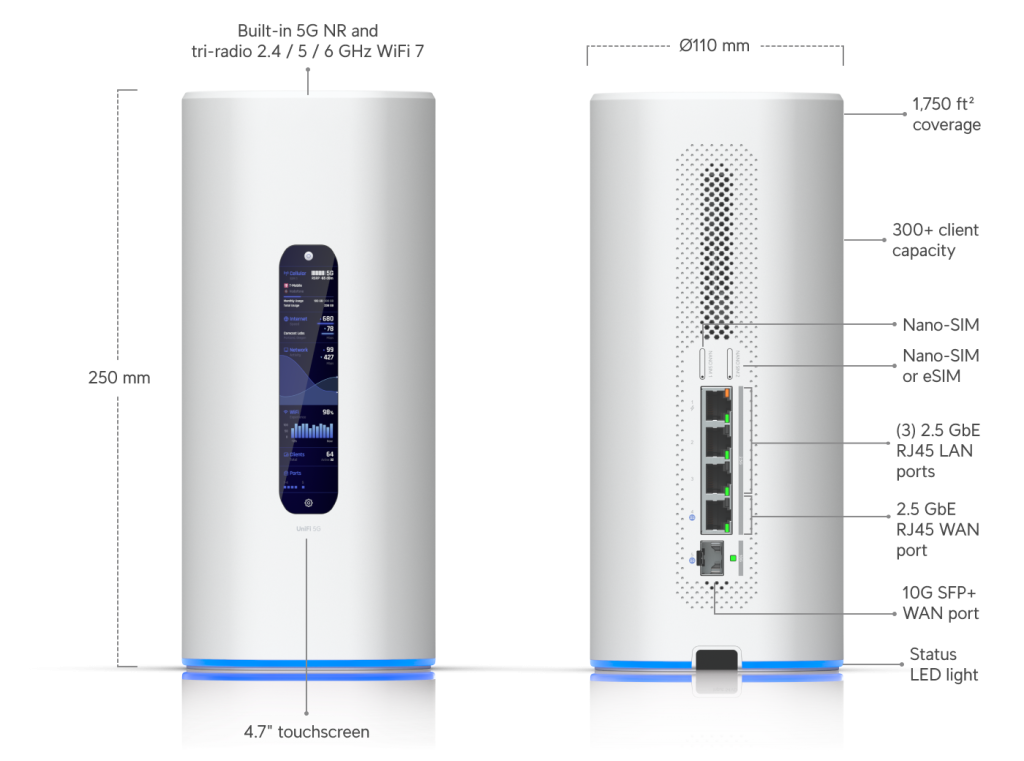
The 5G modem supports dual SIM – one nano-SIM plus a nano-SIM/eSIM hybrid slot – and delivers up to 3.4Gbps downlink on 5G NSA networks across Sub-6 bands. The hardware is unlocked and covers virtually all global Sub-6 carriers.
At $499 – roughly £400 – it is remarkable value for what it delivers.
The other thing worth mentioning is the 4.7-inch touchscreen on the front. It displays live connection status, WAN information, and speed test results. You can restart the device from it. Run a speed test. It sounds like a minor feature until you hand a device to someone who is not a network engineer and watch them actually use it. For anyone who remembers Option NV’s GlobeSurfer routers from the mid-2000s – one of the few manufacturers who briefly put screens on routers before the market decided nobody wanted them – there is a satisfying sense of an idea whose time has finally come.
The Dream Router 5G Max can also function as a plug-in addition to an existing UniFi deployment alongside the UCG-Industrial, extending the ecosystem with 5G connectivity without replacing existing infrastructure. The UniFi platform manages both as part of the same network.
The Wi-Fi Story
No overview of the UniFi ecosystem would be complete without mentioning the access point range – because the gateway hardware is only part of the picture.
UniFi Wi-Fi 7 access points – including the U7 series – integrate directly with the UCG-Industrial and the Dream Router 5G Max to form a managed mesh or multi-AP wireless network. The gateway acts as the controller. The APs report into it. Coverage, roaming, bandwidth management, and guest network configuration are all handled centrally through the UniFi interface.
For a construction site that needs reliable wireless across multiple cabins, or a rural business with buildings spread across a yard, the combination of a 5G-connected gateway and a handful of UniFi APs is a clean, manageable, and cost-effective solution. Add PoE cameras on the same switch ports and you have site security covered from the same platform.
Use Cases – Where This Hardware Makes Sense
Construction sites and temporary installations. The Dream Router 5G Max is the obvious choice – single device, 5G primary with SIM failover, Wi-Fi 7 for the site cabin, PoE for a camera. Set up in twenty minutes, moved to the next site when the job is done.
Rural businesses on poor fixed broadband. 5G FWA via the Dream Router 5G Max as primary broadband is a credible solution where fibre has not arrived and is not arriving any time soon. Real-world Sub-6 speeds of 150-400Mbps are achievable on a decent signal – more than adequate for most small office workloads.
Remote industrial sites and unmanned facilities. The UCG-Industrial paired with the 5G Max Outdoor makes a serious case here. Ruggedised gateway, external 5G modem mounted for best signal, Remote SIM management from the indoor unit, 350W of PoE for cameras and sensors, and centralised management from head office through UniFi.
Small branch offices and pop-up retail. A single gateway that handles routing, wireless, 5G failover, and camera recording – managed remotely alongside every other site through a single interface, with no licencing overhead – simplifies multi-site deployments significantly.
MSPs and network installers. The UniFi platform’s centralised management model, combined with hardware that handles more functions in fewer devices, makes this a commercially interesting proposition for anyone managing connectivity at scale.
One Honest Caveat
UK carrier certification for the Dream Router 5G Max is not yet confirmed across all major networks. The hardware is unlocked and the Sub-6 band support list is extensive, but if you are deploying in the UK as a primary broadband solution, verify band compatibility with your intended carrier before committing. The US launch has certified AT&T and T-Mobile, with Verizon support in progress. UK formal certifications are expected to follow.
Wrapping Up
Ubiquiti has moved into cellular connectivity with more thought than most of the mainstream networking brands have managed. The UCG-Industrial is a serious piece of kit for serious installations. The Remote SIM architecture is a practical answer to a real problem. The Dream Router 5G Max is, frankly, one of the most complete 5G FWA products available at this price point.
For construction companies, rural businesses, remote sites, and small offices that need connectivity that actually works – this range deserves a serious look.
Peter Green is a cellular connectivity specialist with over two decades of experience in M2M, IoT, and 5G infrastructure. Find more on 5G technology at 5gredcap.co.uk, on eSIM and eUICC at euicc.co.uk, and on SGP.32 IoT eSIM standards at sgp32.co.uk.