Outdoor 5G no longer has to mean pointing a directional antenna at one fixed mast
The MikroTik LAMP 5G R16 combines an omnidirectional antenna system, a modern Release 16 cellular modem, eSIM, physical SIM support, RouterOS and industrial outdoor protection. It is designed for FWA installations where the best available cellular path may not always come from the same direction.
Key takeaways
- The LAMP 5G R16 is an outdoor 5G router, not merely an external antenna. The cellular modem, antennas, RouterOS platform and Ethernet connection are all contained in the outdoor unit.
- Its defining feature is an omnidirectional 4×4 MIMO antenna system. It is intended for locations with several usable cells, changing network conditions or no obvious single tower to target.
- It supports both 5G Standalone and Non-Standalone networks. It also provides LTE Category 20 fallback across a broad range of European and UK mobile bands.
- Built-in eSIM and a Micro SIM slot provide deployment flexibility. Installers can use a conventional physical SIM, MikroTik Connectivity or supported third-party eSIM services and profiles.
- IP67 protection, a -40°C to +70°C tested temperature range and EN 60945 maritime compliance make it relevant to exposed industrial, coastal, transport and marine installations.
- It solves a different problem from MikroTik’s directional ATL 5G R16. The ATL is for deliberately targeting a distant or difficult cell. The LAMP is for adaptable, wide-area signal availability without precision antenna alignment.
The most common advice given to someone struggling with indoor 5G broadband is simple: put the router near a window.
That advice is not entirely wrong. It is simply the cheapest possible response to a radio problem.
A mobile signal arriving from outside must pass through brick, stone, insulation, foil-backed plasterboard, coated glass and whatever else sits between the base station and the modem. Moving an indoor router towards a window may reduce some of that loss, but it does not remove the building from the radio path. It also forces the router to live where the signal happens to be strongest rather than where the Ethernet equipment, firewall, switch or users need it.
An outdoor 5G router changes the architecture. The antennas and cellular modem are placed outside, close together and in clear air. The connection is then carried into the building over Ethernet, which is far less vulnerable to the signal loss and interference problems associated with a long external antenna cable.
That basic idea is not new. What is changing is the scale of the market and the variety of locations now using fixed wireless access. FWA is no longer limited to a rural household trying to escape a miserable copper line. It is being used for business broadband, rapid deployment, construction sites, retail continuity, temporary infrastructure, CCTV, public Wi-Fi, ports, utilities, transport, energy and genuine network resilience.
As discussed in our analysis of why thousands of additional FWA masts are planned while full fibre continues to expand, wireless broadband is not disappearing as fibre coverage rises. It is becoming more specialised. The market increasingly values connections that can be installed quickly, moved when necessary, deployed where digging is uneconomic and used as a genuinely separate path from fixed-line infrastructure.
The MikroTik LAMP 5G R16 has been designed for this broader market.
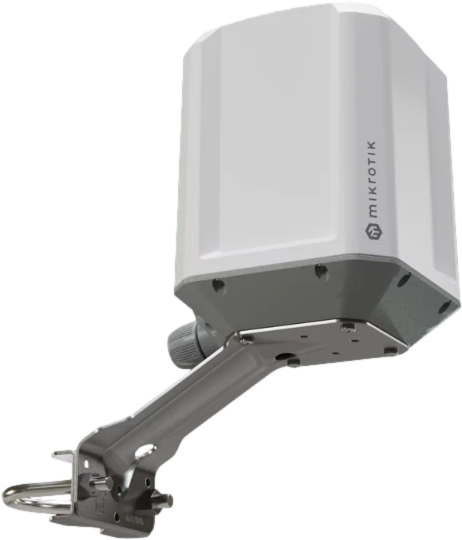
What problem does the MikroTik LAMP 5G R16 solve?
Outdoor cellular equipment has traditionally followed one of two designs.
The first is a separate router installed indoors with one or more antenna cables running to an external antenna. This can work, but high-frequency cellular signals do not travel through coaxial cable for free. Every metre introduces loss. Cable quality, connector quality, frequency and cable length all affect how much of the signal actually reaches the modem.
The second design moves the modem outdoors and combines it with a directional antenna. This is often the right answer in a deep rural or fringe-coverage location. An installer identifies the useful mast, points the antenna towards it and concentrates the available antenna gain in that direction.
But not every 5G FWA installation is a rural cottage with one distant mast visible across a field.
In towns, cities, ports, distribution centres, industrial estates and transport hubs, several base stations may be within reach. The strongest cell at the time of installation may not remain the best-performing cell throughout the day. Network maintenance, cell loading, propagation changes, operator configuration and local obstructions can alter the available service.
A directional unit remains physically pointed in the direction chosen by the installer. The modem may still select another cell where technically possible, but the antenna system is optimised for the original direction. A different tower behind or to the side of the unit may be available, yet receive much less antenna gain.
The LAMP 5G R16 takes another approach. Its antenna system is omnidirectional, allowing the modem to work with suitable cellular signals arriving from around the installation rather than concentrating its reception into one narrow direction.
The LAMP 5G R16 is not intended to outperform a correctly aligned high-gain directional antenna at an extreme rural location. It is intended to provide a more adaptable connection where several towers or signal paths may be available and precise antenna alignment would add complexity without necessarily improving resilience.
Why outdoor 5G routers are becoming more important
The outdoor 5G router is moving from specialist equipment towards a mainstream part of the broadband toolkit. Several forces are pushing the market in the same direction.
5G is being used as fixed infrastructure
Mobile networks were originally designed and marketed around people carrying phones. Fixed wireless access changes the demand pattern. A router may remain connected from the same location for months or years, serving an entire home, office, branch, camera estate or industrial network.
That places greater importance on antenna position, uplink quality, cell selection, signal consistency and installation design. A phone can be moved to another room or taken outside. A fixed router needs to work where it has been installed.
The remaining broadband gaps are harder
Fibre deployment naturally reaches the most commercially attractive premises first. The final portion includes long private roads, rural businesses, farms, scattered properties, temporary sites and locations where wayleaves or civil engineering costs make a wired connection slow or uneconomic.
Those are exactly the places where placing the cellular modem outdoors can turn a marginal mobile signal into a usable broadband service.
Businesses now treat cellular as infrastructure
A business may use 5G as its primary connection, but the resilience market is just as important. A second fibre service entering through the same duct does not necessarily provide a genuinely separate route. An outdoor 5G router can provide a path that does not depend on the same trench, cabinet, pole or local access network.
Temporary no longer means low priority
Construction compounds, events, temporary retail units, site offices and emergency operations may exist for months rather than years, but they still need cloud applications, VoIP, CCTV, access control, payment systems and VPN connectivity.
The project may be over before a fixed-line order is completed. Outdoor 5G provides an installation model measured in hours or days rather than months.
Modern buildings are increasingly hostile to radio
Energy-efficient construction can be remarkably effective at keeping mobile signals outside. Insulation materials, treated glazing, reinforced concrete and metal cladding can all reduce indoor cellular performance. An outdoor router avoids asking the signal to penetrate the building before it reaches the modem.
How the LAMP 5G R16 antenna system works
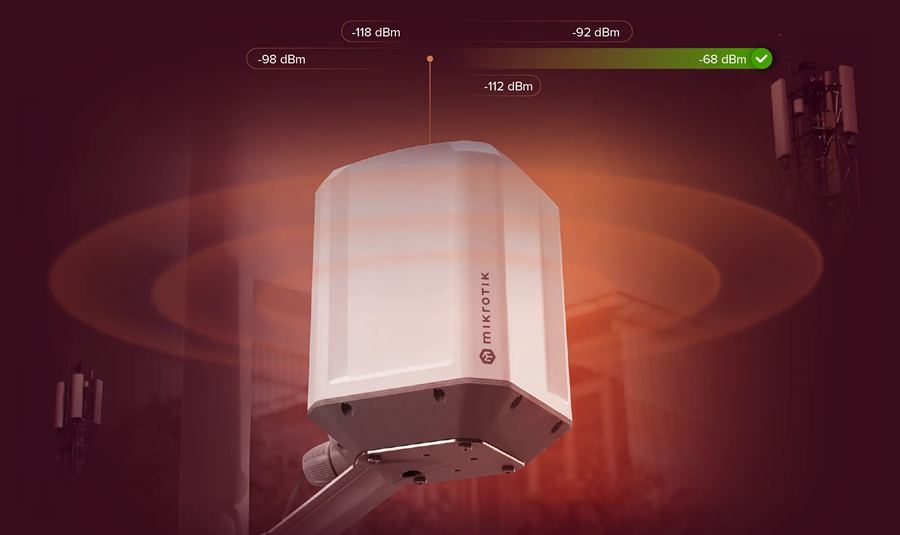
The antenna system is what makes the LAMP different from the more familiar dish, panel or grid-style outdoor cellular CPE.
An omnidirectional antenna does not literally receive every signal equally in every three-dimensional direction. Real antenna patterns have peaks, dips and differences by frequency. The useful distinction is that the LAMP is designed to provide broad coverage around the installed unit rather than concentrating most of its useful gain into one narrow horizontal sector.
That makes installation simpler. The installer still needs to choose a sensible position with height, separation from obstructions and a practical cable route. However, there is no requirement to perform fine directional alignment towards a particular mast.
This matters where the radio environment is complicated. In an urban location, the usable path may not even be a simple line between the router and the mast. Signals can arrive through reflections from buildings and other structures. At a port or industrial site, containers, vehicles, machinery and temporary structures can alter the local environment. On a moving or relocatable asset, the direction of the serving cell may change completely.
The modem remains responsible for network and cell selection. The antenna cannot instruct the network to move a connection to a better tower, nor can it overcome operator steering, SIM restrictions or network policies. What the broad antenna pattern does is give the modem a better chance of receiving several available options without one of them being rejected simply because it sits outside a narrow directional beam.
The strongest visible cell is not automatically the fastest or most stable. FWA performance also depends on signal quality, interference, available spectrum, carrier aggregation, cell load, network configuration, backhaul and the tariff or SIM service being used. The LAMP improves the installation side of the equation, but it cannot manufacture capacity that the mobile network does not have.
Omnidirectional or directional: which is better?
Neither design is universally better. They solve different radio problems.
| Installation factor | LAMP 5G R16 omnidirectional design | Directional outdoor CPE |
|---|---|---|
| Best environment | Urban, industrial, coastal or multi-cell locations with several possible signal paths | Rural or fringe locations with one known tower or a clearly superior direction |
| Alignment | No precision tower alignment required | Correct aiming can be critical to performance |
| Antenna gain | Distributed around the unit to provide broad coverage | Concentrated towards the target direction |
| Ability to use other directions | Better suited to receiving viable cells from around the installation | Signals away from the antenna’s main beam may be substantially weaker |
| Very distant mast | May not provide enough gain for a severe fringe-coverage site | Usually the stronger choice when maximum gain is needed towards one mast |
| Installation time | Generally quicker because fine alignment is unnecessary | May require surveys, testing, adjustment and re-testing |
| Changing radio conditions | Provides the modem with broader directional availability | Remains physically optimised for the original target direction |
| Relocatable deployments | Strong option where the equipment may be moved between sites | Usually needs realignment at each new location |
The practical purchasing decision is therefore not simply whether an omnidirectional or directional antenna has the bigger gain figure.
Ask what the site actually looks like. Is there one distant tower that must be isolated from interference, or are there several nearby cells that might provide service? Is the unit permanent, relocatable or mobile? Will an installer have the tools and time to align it? Could the serving cell change? Is the location dominated by distance, or by a complicated and changing radio environment?
The specifications that actually matter
| Specification | LAMP 5G R16 | Why it matters |
|---|---|---|
| Product code | LAMPGM&RG520F-EU | European modem variant with broad UK and European band support |
| Cellular modem | Quectel RG520F-EU platform | Modern 5G Release 16 modem supporting SA, NSA and LTE fallback |
| 5G SA performance class | Up to 4.2 Gbps downlink and 900 Mbps uplink | Indicates the modem’s theoretical radio capability; real network speeds will normally be lower |
| 5G NSA performance class | Up to 5.0 Gbps downlink and 650 Mbps uplink | Supports current 5G deployments that use a 4G anchor connection |
| LTE fallback | LTE Category 20, up to 2.0 Gbps downlink and 200 Mbps uplink | Maintains strong 4G capability where 5G is weak, unavailable or unsuitable |
| MIMO | 4×4 downlink, 2×2 uplink | Allows the modem to use multiple radio streams where supported by the serving network |
| UK-relevant 5G bands | Includes n1, n3, n7, n8, n20, n28, n77 and n78 | Covers the important low-, mid- and high-capacity Sub-6 GHz bands used across UK networks |
| SIM support | One Micro SIM slot plus built-in eSIM | Supports established physical SIM services while enabling remote eSIM provisioning and profile flexibility |
| Ethernet | One 10/100/1000 Mbps port | Provides the wired hand-off into the local router, switch, firewall or network |
| Power | 802.3af/at PoE-in, 12–56 V | Power and Ethernet can share one outdoor cable, simplifying installation |
| Maximum power consumption | 10 W | Modest demand for remote, solar-assisted, battery-backed and industrial deployments |
| Operating system | RouterOS v7, licence level 3 | Provides serious routing, firewall, VPN, monitoring, automation and management functions |
| Processor and memory | Dual-core 800 MHz ARM 64-bit CPU, 512 MB RAM | Sufficient platform for routing and management, although it is not intended to replace a high-end core firewall |
| Environmental protection | IP67 | Protected against dust and temporary water immersion when correctly installed and sealed |
| Temperature range | Tested from -40°C to +70°C | Suitable for exposed outdoor installations across demanding seasonal conditions |
| Maritime standard | Designed to meet EN 60945 requirements | Relevant to ports, marinas, coastal sites and marine communication environments |
| GNSS | GPS, GLONASS, Galileo, BeiDou and QZSS support | Provides positioning data for asset tracking, fleet management and location-aware applications |
| Cooling | Passive | No cooling fan means one less moving component in an exposed outdoor device |
| Included equipment | Mount, 24 V power adapter and Gigabit PoE injector | Provides the main components required for a standard installation |
The theoretical modem speeds should be treated as modem categories, not promises of what any particular UK mast will deliver. The final throughput will depend on available bands, channel bandwidth, carrier aggregation combinations, signal conditions, local demand, operator backhaul, network policy and the Ethernet hand-off.
The LAMP has a single Gigabit Ethernet port, so its practical wired throughput cannot exceed the capacity of that interface. That is not a serious limitation for most FWA installations, but it means the multi-gigabit modem figures should not be mistaken for multi-gigabit LAN delivery.
The cellular modem may be capable of several gigabits under ideal laboratory and network conditions, but the LAMP provides a one-gigabit Ethernet hand-off. Think of the advanced modem as providing broad band support, aggregation capability and headroom rather than as a guarantee of a 5 Gbps speed test.
Why 5G Release 16 matters
The “R16” in the product name refers to the generation of the cellular modem and its support for capabilities associated with 3GPP Release 16.
Release numbers can easily become marketing shorthand. A router does not become dramatically faster simply because “R16” appears on the case. Network features also depend on what the mobile operator has deployed and enabled.
What Release 16 does indicate is that the LAMP is based on a more modern 5G platform than the first generation of 5G routers built around earlier NSA-focused modems. It supports both 5G Non-Standalone and Standalone operation and is better aligned with the way mobile networks are developing.
For an FWA buyer, the important point is useful product life. Outdoor equipment is often installed high on a wall, pole, mast, rooftop or gantry. Replacement is more disruptive than swapping a desktop router. Buying a platform that supports the current NSA network while also accommodating growing SA deployment is sensible engineering.
5G Standalone and Non-Standalone support
Most early 5G services used Non-Standalone architecture. The 5G radio connection operated alongside a 4G anchor, allowing operators to introduce 5G coverage while continuing to rely on parts of the existing LTE network core.
Standalone 5G removes that dependency and connects through a 5G core. In principle, this provides a better foundation for lower latency, service differentiation, network slicing and more flexible handling of uplink and downlink resources.
For fixed wireless access, uplink behaviour can matter as much as headline download speed. Video conferencing, remote desktop sessions, CCTV, cloud backup, VPN traffic and industrial data transfer all rely on upstream performance and consistency.
The LAMP’s support for both architectures means it can operate on the networks available today while remaining relevant as operators expand SA coverage. It does not mean every SA feature will automatically be available to every SIM. The mobile operator, tariff, network location and subscription still determine which services the device can use.
Physical SIM and eSIM without the fairy dust
The LAMP 5G R16 includes both a Micro SIM slot and built-in eSIM capability.
The physical slot matters because conventional SIM cards remain the standard deployment method for a huge proportion of business and industrial cellular services. A customer can use an existing single-network SIM, roaming SIM, private APN service, fixed-IP SIM or managed IoT connectivity agreement, subject to modem and network compatibility.
Built-in eSIM adds another route. MikroTik states that the device works with MikroTik Connectivity and can also support third-party eSIM providers and multiple eSIM profiles. That can simplify commissioning, particularly where equipment is being prepared centrally and sent to different locations.
It can also reduce the need to reopen an outdoor enclosure merely to replace a plastic SIM. This becomes increasingly valuable when the router is installed on a roof, pole, vessel, mast or secured industrial site.
However, eSIM should not be described as automatic multi-network failover by itself. An eSIM is a programmable SIM platform. The actual network choices, roaming permissions, profile downloads, switching process, remote management model and commercial terms depend on the eSIM service being used.
Likewise, storing multiple profiles does not necessarily mean the device can instantly or autonomously switch between them whenever a mast becomes congested. That behaviour depends on the profiles, management platform, RouterOS implementation and operator service.
The useful feature is not “eSIM instead of SIM”. It is the ability to support established physical SIM deployments while also offering a programmable route for remote provisioning, alternative operator profiles and future connectivity models.
RouterOS turns it into more than outdoor CPE
Many outdoor 5G CPE products are designed as controlled appliances. They provide an internet connection and a limited set of configuration options. The LAMP runs MikroTik RouterOS v7, giving it a much broader networking toolkit.
Depending on the required architecture and available RouterOS functionality, this can include firewall rules, NAT, VLANs, DHCP, static routes, dynamic routing functions, quality-of-service controls, traffic monitoring, scheduled scripts, remote logging and VPN services.
That does not mean every function should be piled onto the outdoor unit. In a business installation, the LAMP may be best used as the cellular edge device while a separate firewall or router handles the main LAN, security policies and user network.
But RouterOS gives the installer a choice. The LAMP can operate as a relatively self-contained router for a small site, or it can be incorporated into a larger MikroTik or mixed-vendor architecture.
For managed estates, scripting and monitoring are especially relevant. Cellular installations do not fail only by going completely offline. They can remain technically connected while performance deteriorates. Being able to inspect signal metrics, interface state, traffic behaviour and connectivity tests is far more useful than a single green “online” indicator.
Why PoE is the right installation method
The LAMP is powered through its Gigabit Ethernet port using 802.3af/at PoE, with a supported input range of 12 to 56 volts. MikroTik includes a Gigabit PoE injector and a 24 V power adapter.
This allows a single Ethernet cable to carry both power and data between the indoor network and the outdoor router. There is no separate mains supply required at the mounting position.
That simplifies weatherproofing, cable management and installation. It also makes central backup power easier. If the indoor PoE source or injector is connected to a UPS, the outdoor router can remain powered during a local mains interruption.
Cable quality still matters. Outdoor-rated UV-resistant Ethernet cable should be used where the run is exposed. Correct earthing, surge protection, drip loops, gland sealing and lightning risk assessment should form part of the installation rather than being treated as optional decoration.
IP67 and EN 60945: built for more than a garden wall
The LAMP carries an IP67 rating and has been tested across an ambient temperature range of -40°C to +70°C.
IP67 indicates a high level of protection against dust and water ingress when the product is correctly installed. It does not make careless installation harmless. A badly fitted cable gland, damaged seal or poorly routed cable can undermine an otherwise weatherproof enclosure.
MikroTik also positions the product for maritime environments and states that it is designed to meet EN 60945 requirements. That standard is associated with maritime navigation and radiocommunication equipment and includes environmental and electromagnetic considerations relevant to marine use.
This makes the LAMP particularly interesting for ports, marinas, harbours, coastal monitoring, dockside systems and vessel connectivity. It should not, however, be confused with certified safety-critical navigation equipment.
The built-in GNSS capability supports GPS, GLONASS, Galileo, BeiDou and QZSS positioning systems. MikroTik describes this as suitable for positioning, tracking and non-critical location-aware applications, not navigation or safety-critical marine guidance.
Real-world applications for the LAMP 5G R16
The broad antenna pattern, outdoor construction, SIM flexibility and RouterOS platform make the LAMP suitable for considerably more than rural home broadband.
Business primary broadband
Rapid internet delivery for offices, workshops and commercial units where fibre is unavailable, delayed or disproportionally expensive.
Fibre and leased-line failover
A diverse cellular path that does not depend on the same local duct, cabinet, pole or fixed access infrastructure.
Construction sites
Connectivity for site offices, CCTV, access control, cloud applications, VoIP and contractor networks without waiting for a fixed circuit.
Ports and marinas
Outdoor connectivity in exposed coastal environments where available cells may sit in several directions around the site.
Vessels and floating assets
Non-safety-critical internet connectivity where orientation and the available serving cell can change as the vessel moves.
Industrial estates
Connectivity for units with poor indoor signal, metal cladding or changing radio paths caused by buildings, vehicles and machinery.
Warehouses and distribution centres
An external cellular edge for cloud systems, handheld terminals, security, loading operations and business continuity.
Retail branches
Primary or backup connectivity for payment services, stock systems, VoIP, digital signage and guest Wi-Fi.
Pop-up shops and temporary premises
A service that can be commissioned quickly and moved when the temporary operation closes or changes location.
Events and festivals
Internet access for organisers, ticketing, traders, production systems, CCTV and operational communications.
CCTV and ANPR
Outdoor backhaul for cameras and recording systems where wired connectivity is unavailable or needs a separate recovery path.
Car parks
Connectivity for payment terminals, barriers, occupancy monitoring, intercoms, EV charging and security systems.
EV charging sites
WAN access for charger management, payment authorisation, monitoring and support at exposed or difficult-to-cable locations.
Renewable energy
Remote connectivity for solar farms, wind sites, battery storage systems and distributed energy monitoring.
Utilities
Communications for pumping stations, substations, telemetry equipment, water assets and remote operational systems.
Agriculture
Broadband for farm offices, machinery yards, cameras, environmental monitoring and connected agricultural systems.
Caravan and holiday parks
Backhaul for office systems, guest internet, security and site operations where several mobile cells may be available.
Transport depots
Connectivity for fleet systems, CCTV, maintenance operations, staff networks and temporary overflow areas.
Roadside infrastructure
Outdoor WAN access for signs, monitoring, ticketing, cameras and non-safety-critical roadside systems.
Emergency replacement connectivity
A quickly deployed alternative following cable damage, premises moves, network failure or delayed circuit provision.
Where the LAMP may not be the right choice
A proper review should say where a product fits and where it does not.
The LAMP’s omnidirectional design may be less suitable for an extreme fringe-coverage location where one distant tower needs every possible decibel of directional antenna gain. A product such as a high-gain directional outdoor router may deliver a stronger and cleaner link when correctly aligned.
It may also be the wrong choice where the customer requires a multi-gigabit wired LAN connection. The LAMP has a single Gigabit Ethernet port. That is entirely adequate for most business, industrial and residential FWA services, but it creates a clear wired ceiling below the modem’s theoretical maximum radio rates.
There is no integrated Wi-Fi access point listed as part of the product proposition. In most professional installations that is not a disadvantage. The outdoor router should feed a suitable indoor firewall, switch or wireless system. Buyers looking for an all-in-one indoor 5G Wi-Fi router are shopping for a different category of product.
Finally, an omnidirectional design should not be mistaken for an automatic cure for congestion. It may give the modem access to more viable signal directions, but it cannot force an operator to provide more spectrum, move the SIM to a different network or bypass a heavily loaded cell.
How to plan a LAMP 5G R16 installation
1. Survey more than signal bars
Check the available networks, bands, signal strength, signal quality, latency, upload performance and behaviour at different times of day. A five-minute daytime speed test may not represent evening or peak-hour performance.
2. Choose height carefully
Higher is often better, but not automatically. The aim is to reduce nearby obstruction and improve the radio environment without creating an unnecessarily difficult cable route, unsafe access requirement or lightning risk.
3. Test the intended SIM service
Two SIMs using the same underlying network can behave differently because of tariffs, APNs, roaming arrangements, traffic policies and service priorities. Test the actual service being proposed rather than assuming the network logo tells the whole story.
4. Decide which device performs routing
The LAMP can provide RouterOS routing functions, but some installations will be cleaner with a separate indoor firewall or router. Define responsibility for NAT, DHCP, VPN, VLANs, failover and security before deployment.
5. Protect the cable route
Use suitable outdoor Ethernet cable, weatherproof entry points, strain relief, grounding and surge protection. An IP67 router attached to unsuitable cabling is not an IP67 installation.
6. Build remote management in from the start
Confirm how the router will be reached behind CGNAT, which management services will be enabled, how credentials are controlled, where logs are sent and how firmware and configuration changes will be handled.
Is the MikroTik LAMP 5G R16 a significant product?
Yes, although not because it claims the biggest directional antenna gain or the highest possible speed-test figure.
Its importance is that it reflects how the FWA market is widening.
The first wave of outdoor mobile broadband equipment was largely about extracting a usable signal from a remote tower. That use case remains important, but it is no longer the whole market. Outdoor 5G is now being installed in dense, changing and operationally important environments where flexibility can matter more than concentrating all antenna gain in one direction.
The LAMP brings together several capabilities that suit that shift: a broad 4×4 MIMO antenna arrangement, current 5G SA and NSA support, strong LTE fallback, physical SIM and eSIM options, PoE, RouterOS, GNSS, IP67 protection and maritime-oriented construction.
It also makes deployment easier. Not every site requires an installer to spend an hour rotating a directional unit by a few degrees while watching SINR values. Where several cells are available, removing precision alignment can reduce installation time and make the product easier to move or redeploy.
This is not the outdoor router for every location. It is the outdoor router for locations where the old assumption of one fixed tower, one fixed direction and one permanent radio path no longer matches reality.
Our view
The MikroTik LAMP 5G R16 is one of the more interesting outdoor 5G routers because its design starts with the environment rather than the marketing speed.
It accepts that urban, industrial, transport and coastal radio conditions can be messy. There may be several towers, several reflected paths and substantial changes in local conditions. A precisely aligned antenna is excellent when the installer knows exactly what it should be aligned towards. It is less useful when adaptability is the real requirement.
The physical SIM and eSIM combination is sensible rather than gimmicky. RouterOS provides considerably more networking control than a basic consumer outdoor CPE. PoE keeps installation practical. The environmental ratings make it credible for exposed deployments rather than merely weather-resistant in the loosest possible sense.
The main cautions are equally clear. It has a one-gigabit Ethernet hand-off, it will not replace a high-gain directional unit in every weak-signal location and it cannot solve network congestion or poor SIM service design.
Used for the right site, however, the LAMP 5G R16 represents exactly where professional fixed wireless access is heading: outdoor, remotely manageable, operator-flexible and designed around the reality that the best available cellular path may change.
Discuss a MikroTik LAMP 5G R16 deployment
Send your site details, intended application and current connectivity problem. Your enquiry will be identified as relating to the MikroTik LAMP 5G R16 and this 5GFWA.co.uk article.
For the complete manufacturer specification, supported cellular bands, power details, dimensions and included components, download the MikroTik LAMP 5G R16 datasheet.
Frequently asked questions
What is the MikroTik LAMP 5G R16?
The MikroTik LAMP 5G R16 is a weatherproof outdoor 5G router combining an omnidirectional cellular antenna system, 5G and LTE modem, RouterOS, Gigabit Ethernet, PoE-in, physical Micro SIM support, built-in eSIM and GNSS. It is designed for fixed wireless access, backup connectivity and outdoor industrial or marine installations.
Does the LAMP 5G R16 support UK 5G networks?
The European LAMPGM&RG520F-EU variant supports a broad range of 5G and LTE bands relevant to UK mobile networks, including 5G bands n1, n3, n7, n8, n20, n28, n77 and n78. Actual service depends on the mobile operator, SIM, available local bands and network configuration.
Does the MikroTik LAMP 5G R16 support 5G Standalone?
Yes. The LAMP 5G R16 supports both 5G Standalone and 5G Non-Standalone operation. Whether the router connects using SA depends on the mobile network, local coverage, SIM subscription and operator provisioning.
Is the LAMP 5G R16 directional or omnidirectional?
It uses an omnidirectional antenna system. It is designed to work with suitable signals arriving from around the installation rather than concentrating its antenna gain towards one precisely aligned tower. This makes it particularly relevant where several cells may be available or network conditions change.
Is an omnidirectional outdoor router better than a directional router?
It depends on the site. An omnidirectional router is often better where several towers or signal paths are available, where installation must be quick or where the equipment may be moved. A directional router is usually better in severe fringe coverage where maximum gain towards one known distant tower is required.
Does the LAMP 5G R16 have eSIM?
Yes. It includes built-in eSIM and also has one physical Micro SIM slot. MikroTik states that it supports MikroTik Connectivity, third-party eSIM providers and multiple eSIM profiles. The available remote provisioning and profile-switching functions depend on the selected eSIM provider and service.
Can eSIM make the router automatically switch mobile networks?
Not by itself. eSIM allows supported operator profiles to be downloaded, stored and managed without inserting a new plastic SIM. Automatic switching between networks depends on the connectivity service, available profiles, management platform, router configuration and operator rules.
Does the LAMP 5G R16 include Wi-Fi?
The product is designed as an outdoor cellular router with a Gigabit Ethernet hand-off rather than as an indoor Wi-Fi access point. A typical installation connects it to an indoor router, firewall, switch or Wi-Fi system.
How is the LAMP 5G R16 powered?
It uses 802.3af/at PoE-in through its Gigabit Ethernet port and accepts 12 to 56 volts. MikroTik includes a 24 V power adapter and Gigabit PoE injector. This allows power and data to use the same Ethernet cable.
Is the MikroTik LAMP 5G R16 waterproof?
It is rated IP67, providing strong protection against dust and water ingress when correctly installed. The complete installation still needs suitable outdoor cable, properly sealed entries, correct mounting and appropriate surge and lightning protection.
What is EN 60945 and why does it matter?
EN 60945 relates to maritime navigation and radiocommunication equipment and includes environmental and electromagnetic requirements. MikroTik positions the LAMP for ports, marinas, coastal infrastructure and vessel deployments. Its GNSS function is not intended for safety-critical navigation.
What speeds can the LAMP 5G R16 deliver?
The modem specification lists theoretical radio rates of up to 4.2 Gbps down and 900 Mbps up in 5G SA, up to 5.0 Gbps down and 650 Mbps up in 5G NSA, and LTE Category 20 rates up to 2.0 Gbps down and 200 Mbps up. Real throughput will be lower and the wired connection is limited by its one-gigabit Ethernet port.
Can the LAMP 5G R16 be used for business failover?
Yes. It can provide a cellular backup path for fibre, leased lines or other fixed connections. RouterOS can be incorporated into a failover design, or the LAMP can feed a separate business firewall that manages the primary and backup WAN connections.
Can the LAMP 5G R16 be used for rural broadband?
Yes, particularly where several usable cells are available and the outdoor position provides a major improvement over an indoor router. In very weak rural coverage with one distant mast, a high-gain directional outdoor router may be more appropriate.
Sources: MikroTik LAMP 5G R16 product specifications. MikroTik LAMP 5G R16 product brochure. MikroTik RouterOS documentation. Ofcom Connected Nations Planned Network Deployments 2026. Ericsson FWA Handbook 2026. Specifications and network compatibility should be checked again before purchase or deployment.